Calorie Deficit + Strength Training: How to Lose Fat Without Losing Muscle
Eat less than you burn and the scale drops. But without the right protein and the right training, a large share of what leaves is muscle, not fat.
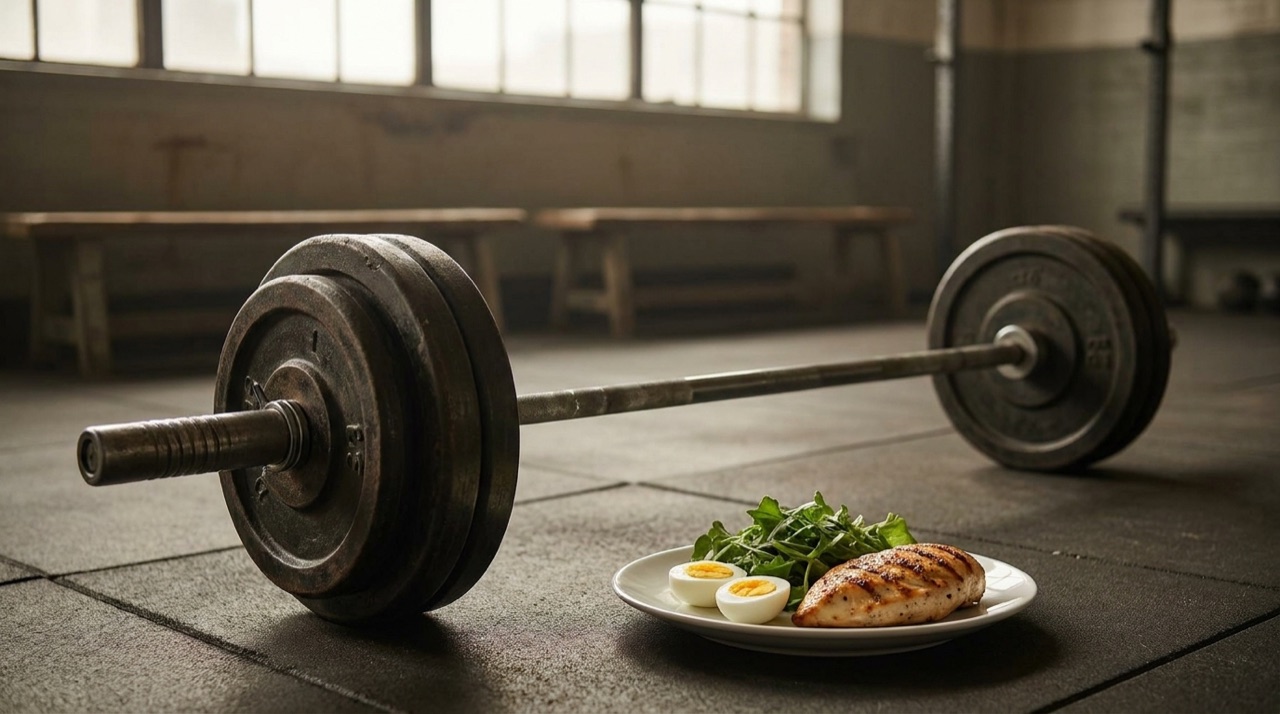
You decide to lean out. You cut portions, drop the snacks, maybe skip a meal, and within a fortnight the scale rewards you. It feels like the plan is working. The reasonable assumption is that a lighter number means a leaner you, and that as long as the weight keeps falling you are winning.
The truth is more awkward. A calorie deficit is a blunt tool. It removes tissue, but it does not care which tissue. Some of what you lose is fat, and some of it is the muscle you would much rather keep. How to lose fat and keep muscle is not decided by the size of the deficit alone. It is decided by two things the deficit ignores: how much protein you eat, and whether you keep lifting. The research on this is unusually clear, and it points the other way from the crash-diet instinct.
Train smarter with Pocket Fit. It holds your food and your training in one place, which is exactly where fat loss without muscle loss is won or lost. Free on the App Store and Google Play, no card needed.
What a calorie deficit actually is
A calorie deficit means you take in less energy than your body spends. Do that consistently and your body makes up the shortfall from its own stores. That is the whole mechanism of fat loss, and there is no way around it. Nothing here argues with the maths.
The honest part is what the maths does not say. Your body does not read the deficit as "burn fat only". It draws on fat and on lean tissue, and the balance between the two is not fixed. It shifts depending on what else is going on. A deficit with no protein and no training pulls a lot of muscle out with the fat. The same deficit with enough protein and hard lifting pulls far less. Eating in a deficit while lifting is a different physiological situation from eating in a deficit and sitting still, even when the calorie numbers are identical.
So the deficit is necessary and it is not the whole story. It sets how much weight you lose. It does not, on its own, decide what that weight is made of. That second question is the one this post is about, and it is the one that actually shows up in the mirror.
Why protein and lifting protect muscle in a deficit
The clearest single study here is Longland and colleagues, published in The American Journal of Clinical Nutrition in 2016. They took 40 overweight young men and put every one of them into a steep deficit, around 40% below their needs, for four weeks. Everyone trained hard: resistance work plus high-intensity intervals, six days a week. All food was provided and measured. The only difference between the two groups was protein. One group ate 1.2 g of protein per kilogram of bodyweight a day. The other ate 2.4 g per kilogram, twice as much.
Both groups lost a similar, large amount of fat. What separated them was lean mass. The lower-protein group roughly held their muscle. The higher-protein group actually gained about 1.2 kg of lean mass while losing fat, in a 40% deficit. That is body recomposition in its starkest form: two things moving in opposite directions at once, driven by protein and training rather than by the size of the cut.
Longland is one trial, but it does not stand alone. Helms and colleagues reviewed the wider evidence in the International Journal of Sport Nutrition and Exercise Metabolism in 2014, pooling the controlled studies on already-lean, resistance-trained people who were dieting. Their conclusion was a protein target, not a promise: intakes of roughly 2.3 to 3.1 g per kilogram of fat-free mass, scaled up as the diet gets harder and the person gets leaner. The leaner you already are and the steeper the deficit, the more protein it takes to defend the muscle. Protein intake for fat loss is not one fixed number; it rises with the difficulty of the job.
What the training side adds
Protein is half the answer. The other half is the resistance training itself, and there is a large analysis that isolates it. Murphy and Koehler, in the Scandinavian Journal of Medicine & Science in Sports in 2021, ran a meta-analysis and meta-regression across trials of people lifting in an energy deficit versus lifting with enough energy.
Their finding is worth reading carefully. Energy deficiency impaired gains in lean mass but did not impair gains in strength. In plain terms: dieting makes it harder to add muscle size, but you can still get stronger while you do it, and the training is still what tells your body to hold onto the muscle it has. Stop lifting in a deficit and you remove the signal that says "keep this tissue". Keep lifting and you keep the signal, even if the scale is falling.
Put the two studies together and the practical shape is simple. Protein supplies the raw material to defend or build muscle. Resistance training is the instruction to spend that material on muscle rather than lose it. Take away either one and the deficit reverts to its blunt default, stripping fat and muscle together.
Where the evidence runs thin
Be straight about the limits, because they matter. Longland's 40 participants were all young men, overweight, and living under near-perfect conditions with every meal cooked and handed to them for four weeks. That is a clean experiment and an unrealistic life. Whether a 2.4 g per kilogram intake and six days of hard training is something you can hold for months, around a job and a family, is a question the study never had to answer.
The reviews inherit the same gaps. Much of this literature is short-term, skewed towards men, and often towards trained lifters rather than complete beginners. The protein ranges from Helms are recommendations drawn from a modest number of studies, not laws of nature. And "gained 1.2 kg of lean mass in a deficit" is a group average under ideal control, not a figure anyone should expect to hit on their own kitchen and schedule.
None of that overturns the direction of the evidence, which is consistent: enough protein plus resistance training shifts loss towards fat and away from muscle. It just means the honest takeaway is a process, not an outcome. Do these behaviours and you tilt the odds. No study, and no app, can hand you a specific number of kilograms or a timeline.
How to set your targets as a process
Because the evidence points at behaviours rather than results, the sensible way to use it is to set process targets you can actually keep, then let the changes follow. Three moves cover most of it.
- Keep the deficit moderate. You do not need a 40% cut to lose fat, and steeper is not safer for muscle. A smaller, steadier shortfall you can hold for months protects muscle and your sanity better than a crash you abandon.
- Aim protein high, roughly 1.6 to 2.4 g per kilogram of bodyweight a day. The lower end is plenty for many people. Push towards the higher end the leaner you already are and the harder you are dieting, in line with the Helms range. Spread it across your meals.
- Keep lifting, and keep it hard. Two to four resistance sessions a week, with real effort, is the signal that tells your body to hold its muscle. On a deficit you may not add much size, but Murphy's data says you can hold and even build strength. That is the goal in a cut.
Notice what is missing from that list: a target weight, a deadline, a dress size. Those are outcomes, and outcomes vary with genetics, starting point, sleep, stress and adherence. The behaviours are the part you control.
Where Pocket Fit fits: food and training together
The reason fat loss with muscle retention is hard in practice is rarely knowledge. It is that the two halves live in two different places. Your food sits in one app and your training in another, and nothing joins them up. Pocket Fit is built to hold both sides in one place, because that intersection is the whole point of the app.
The nutrition side is called Fuel. You scan a plate or a barcode, check the protein, carbs and fat, and see whether your protein is where it needs to be for the day. There are no red numbers and no shame built into it, which matters in a deficit, where a punishing tracker is the fastest way to quit. The training side is a resistance programme that updates week to week from what you log, so the lifting that protects your muscle actually keeps happening rather than quietly lapsing. And the Body budget ties it together into a running tally of four deposits: your workout, your streak, your sleep and your nutrition. It lets you see, on one screen, whether both levers that decide a cut are being pulled, not just the food.
If you want the sleep angle, which is the other lever on what you lose in a deficit, we wrote about it separately in poor sleep and fat loss. And if the tracking part is what puts you off, logging a plate with a photo is meant to make the protein target something you actually keep.
Hit your protein with Pocket Fit. Fuel scans your food and shows your macros, with no red numbers and no shame. Free on iOS and Android.
Put it together
A calorie deficit decides how much weight you lose. Protein and resistance training decide what that weight is made of. Longland showed that doubling protein under a hard deficit and hard training flipped the outcome from holding muscle to gaining it. Helms put a number on the protein it takes as the diet gets harder. Murphy showed that the lifting keeps your strength and the muscle signal alive even when energy is short. Three studies, one message: pull all three levers, not just the food.
The reason the app exists is that I learned this the slow way. When I was losing the 38 kg on the way from 122 kg to competing at The Yard Games, the phases where I only cut food left me lighter and softer than I wanted. The phases where I ate the protein and kept lifting were the ones where the shape changed, not just the number. That lesson is built into how Pocket Fit works. You can read how that went here.
Start with Pocket Fit, free. Track the protein and keep the training that decide a cut, in one app. Personalised in minutes on iOS and Android.
Calorie deficit and strength training: common questions
Can you build muscle in a calorie deficit?
Sometimes, and it depends who you are. In Longland's trial, overweight men eating 2.4 g of protein per kilogram and training hard for four weeks gained about 1.2 kg of lean mass in a 40% deficit. That result is easiest for people newer to lifting or carrying more fat. For lean, experienced lifters the realistic aim in a deficit is holding muscle, not gaining it.
How much protein do I need to lose fat and keep muscle?
The evidence points to a high intake, scaled to how hard you are dieting. Helms and colleagues suggested roughly 2.3 to 3.1 g per kilogram of fat-free mass, rising as you get leaner and cut harder. A simpler working target of 1.6 to 2.4 g per kilogram of bodyweight covers most people. Spread it across your meals.
Is eating in a deficit while lifting better than dieting alone?
Yes, for body composition. A deficit alone removes fat and muscle together. Adding resistance training gives your body the signal to hold its muscle, and Murphy's meta-analysis found you can keep gaining strength in a deficit even when muscle size is hard to add. The lifting is what protects the tissue the deficit would otherwise take.
What is body recomposition?
Body recomposition means losing fat and holding or gaining muscle at the same time, so your shape changes more than your scale weight suggests. It happens when a calorie deficit is paired with enough protein and hard resistance training. It is a process driven by behaviours, not a guaranteed outcome or a fixed timeline.
How big should my calorie deficit be?
Moderate beats extreme for keeping muscle. Longland used a steep 40% deficit under lab conditions, but a smaller, steadier shortfall is easier to hold for months and easier on your muscle and your adherence. The best deficit is the one you can maintain while eating your protein and keeping your training in.
References
- Longland TM, Oikawa SY, Mitchell CJ, Devries MC, Phillips SM (2016). Higher compared with lower dietary protein during an energy deficit combined with intense exercise promotes greater lean mass gain and fat mass loss: a randomized trial. The American Journal of Clinical Nutrition, 103(3), 738-746. DOI: 10.3945/ajcn.115.119339
- Helms ER, Zinn C, Rowlands DS, Brown SR (2014). A systematic review of dietary protein during caloric restriction in resistance trained lean athletes: a case for higher intakes. International Journal of Sport Nutrition and Exercise Metabolism, 24(2), 127-138. DOI: 10.1123/ijsnem.2013-0054
- Murphy C, Koehler K (2021). Energy deficiency impairs resistance training gains in lean mass but not strength: a meta-analysis and meta-regression. Scandinavian Journal of Medicine & Science in Sports, 32(1), 125-137. DOI: 10.1111/sms.14075
Pocket Fit is a fitness and wellbeing app, not a medical device. It does not diagnose, treat or prevent any condition. Always consult a qualified healthcare professional before starting or changing a training or nutrition programme, and if you have persistent problems with sleep, pain or fatigue.
Georgi, founder of Pocket Fit. He went from 122 kg to competing at The Yard Games, having lost 38 kg along the way.
Train smarter with Pocket Fit
Download the app