Mar 21, 2026
Drop Sets and Super Sets for More Results in Less Gym Time
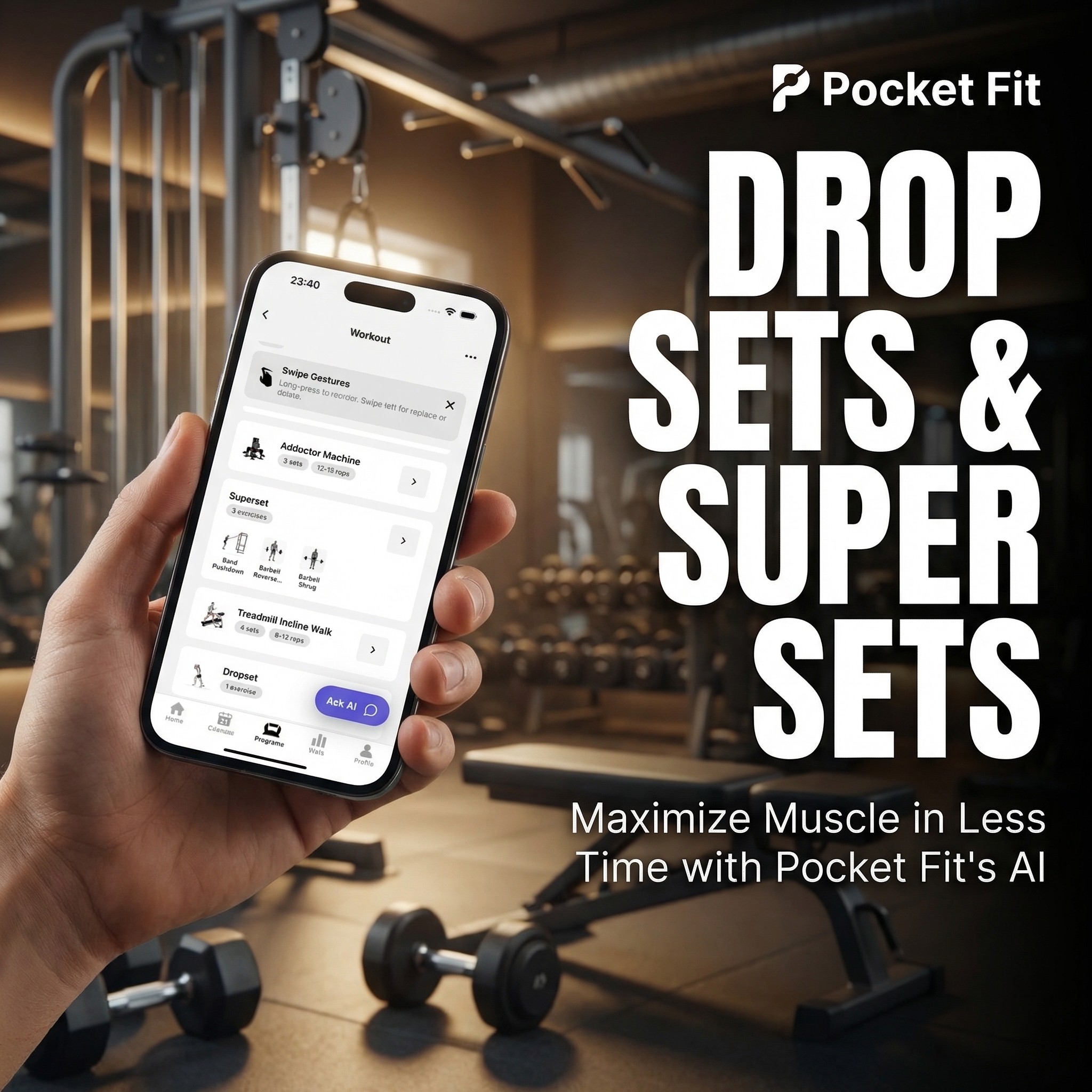
Drop sets and super sets are two advanced training techniques that let you build more muscle in less time by increasing training density. If your sessions are limited, these methods are the most effective ways to maximise results per minute.
Most lifters spend 60 to 90 minutes in the gym and leave with less muscle stimulus than they think. The assumption is that more time equals more results, but the real driver of hypertrophy is training density, not duration. Drop sets and super sets are the most research-supported tools for closing that gap, and most people are either not using them or using them wrong.
Drop Sets and Super Sets Explained: Why These Techniques Deliver More Results in Less Gym Time
If your gym time is limited and your goals are not, drop sets and super sets are two of the most effective training techniques you can add to your programme. Both increase the amount of productive work you do per minute of training, and both have strong mechanistic reasons for triggering muscle growth. Understanding how each one works is the first step toward using them well.
Drop sets involve performing an exercise to near-failure, then immediately reducing the load and continuing for additional reps without rest. This approach maximises motor unit recruitment and metabolic stress in a compressed timeframe. You are essentially extending a set beyond the point where you would normally stop, forcing the muscle to work under accumulating fatigue across multiple load thresholds.
Super sets pair two exercises back-to-back with minimal rest. The pairing can target the same muscle group (agonist super sets) or opposing muscle groups (antagonist super sets). The key advantage is that one muscle recovers while the other works, which maintains mechanical tension across the session while significantly reducing total rest time.
The shared benefit is training density. Both techniques allow you to accumulate more volume per unit of time, which is a critical variable for hypertrophy. For busy professionals and consistency-focused lifters, this means fewer minutes wasted between sets and more stimulus packed into every session.
What the Latest Research Reveals About Muscle Growth from Advanced Set Structures
A 2023 systematic review and meta-analysis examined the effects of drop sets and other advanced set structures on skeletal muscle hypertrophy, comparing them directly against traditional straight sets [1]. The findings are significant for anyone questioning whether time-efficient training methods can genuinely drive muscle growth.
When total training volume was equated, drop sets produced comparable or superior hypertrophy outcomes relative to conventional sets. The critical insight here is the volume-efficiency dimension: lifters using drop sets accumulated similar or greater training volume in significantly less time. For the reader asking "Can I really build muscle without spending more time in the gym?" the research answers affirmatively.
The review also highlighted findings relevant to super sets. Antagonist super set protocols in particular showed minimal performance decrements between paired exercises, meaning force output stayed high across both movements. This makes antagonist pairings a practical and sustainable strategy for lifters who want density without sacrificing quality.
The evidence is clear: advanced set structures are legitimate growth drivers, and their time-saving properties are a bonus built into the mechanism itself.
Why Most Lifters Programme Drop Sets and Super Sets Wrong — and How to Fix It
Knowing that drop sets and super sets work is only half the equation. Programming them poorly can stall progress, spike fatigue, and increase overtraining risk. Here are the four most common mistakes and how to correct each one.
The first mistake is using drop sets on every exercise in a session. This leads to systemic fatigue accumulation, degraded form on later movements, and blunted recovery between sessions. Drop sets should be reserved for one or two key compound or isolation movements per session, placed where the additional metabolic stress adds the most value.
The second mistake is poor super set pairing logic. Pairing two heavy compound movements for the same muscle group, such as squats directly into leg press, spikes fatigue and reduces force output on both exercises. Antagonist or upper/lower pairings are more effective and sustainable, allowing each movement to benefit from the other's recovery window.
The third mistake is placing drop sets at the start of a session. Performing high-fatigue intensification techniques before your primary lifts compromises strength output on the movements that matter most. Position drop sets toward the end of a session, after your main working sets are complete.
The fourth mistake is getting the load drop wrong. Too small a reduction (less than 10%) fails to extend the set meaningfully. Too large a drop (over 40%) shifts the training stimulus away from hypertrophy and toward muscular endurance.
Pro Tip: For drop sets, aim for a 20 to 30 percent load reduction per drop. This keeps rep quality high and metabolic stress in the hypertrophy zone.
How Pocket Fit's AI Builds Drop Sets and Super Sets into Your Personalised Programme
Knowing the theory is valuable. Having an intelligent system apply it to your specific context is where real consistency happens. Pocket Fit has launched drop sets and super sets as core features inside its AI training engine, and the way they are implemented removes the exact programming errors most lifters make on their own.
AI-powered personalised workout programmes: Pocket Fit's AI does not insert drop sets or super sets randomly. It factors in your fitness level, weekly recovery capacity, and programme length to determine where and how often these techniques appear. The placement decisions are driven by the same training density and fatigue management principles covered above, applied automatically to your plan.
Programme customisation across time, equipment, days, and programme length: If your sessions are capped at 40 minutes or you only train three days per week, the AI adjusts how drop sets and super sets are distributed so you still hit your volume targets within those constraints. This is where time-efficient training stops being a concept and becomes a daily reality inside your programme.
AI Personal Coach: When a drop set or super set pairing appears in your plan and you want to understand why, the AI Personal Coach explains the reasoning behind each decision. You get the confidence of knowing your programme is structured with intent, without needing to decode the programming logic yourself.
The three most common mistakes covered in the previous section, pairing, placement, and load selection, are decisions the AI handles automatically. For the time-starved lifter, this means fewer decisions, fewer wasted sessions, and more consistent progress over time.
How to Decide When Drop Sets, Super Sets, or Both Belong in Your Training Week
If you prefer to understand the decision-making process yourself, or you want to validate what your AI plan is doing, this framework gives you a clear starting point.
Identify your primary training goal this block. Hypertrophy-focused blocks favour drop sets for maximising metabolic stress and total volume. Strength or power blocks should limit drop sets and lean on antagonist super sets instead, which maintain force output while still improving session density.
Audit your available session time. If sessions are under 45 minutes, super sets should be the higher-priority technique because they compress inter-set rest without adding significant recovery cost. Drop sets add value but require slightly longer post-set recovery.
Assess your current recovery capacity. If sleep quality is low, life stress is high, or training frequency is already at four or more sessions per week, limit drop sets to one exercise per session. Use antagonist super sets as your primary density tool during these periods.
Consider your training experience. Beginners should master straight sets and develop consistent form before layering in drop sets. Super sets are more accessible at an earlier stage because the technique shift is smaller and exercise pairing logic is easier to learn.
For Pocket Fit users, this decision framework runs automatically inside the AI. Every variable listed above is already accounted for when your programme is generated and adjusted week to week. Whether you train solo or draw motivation from the Members Feed, the system ensures drop sets and super sets appear in your plan at the right time, in the right place, and for the right reasons.
Conclusion
Drop sets and super sets are not shortcuts. They are evidence-backed methods for maximising muscle stimulus within a fixed time window. Used correctly, with proper pairing, placement, and load selection, they outperform traditional straight sets on both efficiency and hypertrophy. The science supports them, and a well-structured programme makes applying them straightforward.
FAQ
What is the difference between a drop set and a super set? A drop set extends a single exercise beyond near-failure by reducing the load immediately and continuing for more reps. A super set pairs two exercises back-to-back with minimal rest. Drop sets maximise metabolic stress on one muscle; super sets improve session density across two movements.
Can beginners use drop sets and super sets? Super sets are accessible to most beginners once basic form is consistent. Drop sets carry a higher fatigue cost and require solid technique under load, so they are better introduced after 8 to 12 weeks of structured training.
How much should you reduce the weight on a drop set? Aim for a 20 to 30 percent load reduction per drop. Less than 10 percent does not meaningfully extend the set, and more than 40 percent shifts the stimulus away from hypertrophy toward muscular endurance.
How often should drop sets and super sets appear in a weekly programme? For most lifters, one to two drop sets per session is sufficient. Super sets can be used more broadly across a session without the same recovery cost. Frequency should decrease when sleep is poor, stress is high, or training days exceed four per week.
Sources
["[1] Schoenfeld, B. J., et al. (2023). 'Effects of Drop Sets on Skeletal Muscle Hypertrophy: A Systematic Review and Meta-analysis.' PMC - PubMed Central. Available at: https://pmc.ncbi.nlm.nih.gov/articles/PMC10390395/"]