Mar 21, 2026
Pocket Fit Has Launched Exercise Tracking for Distance and Time
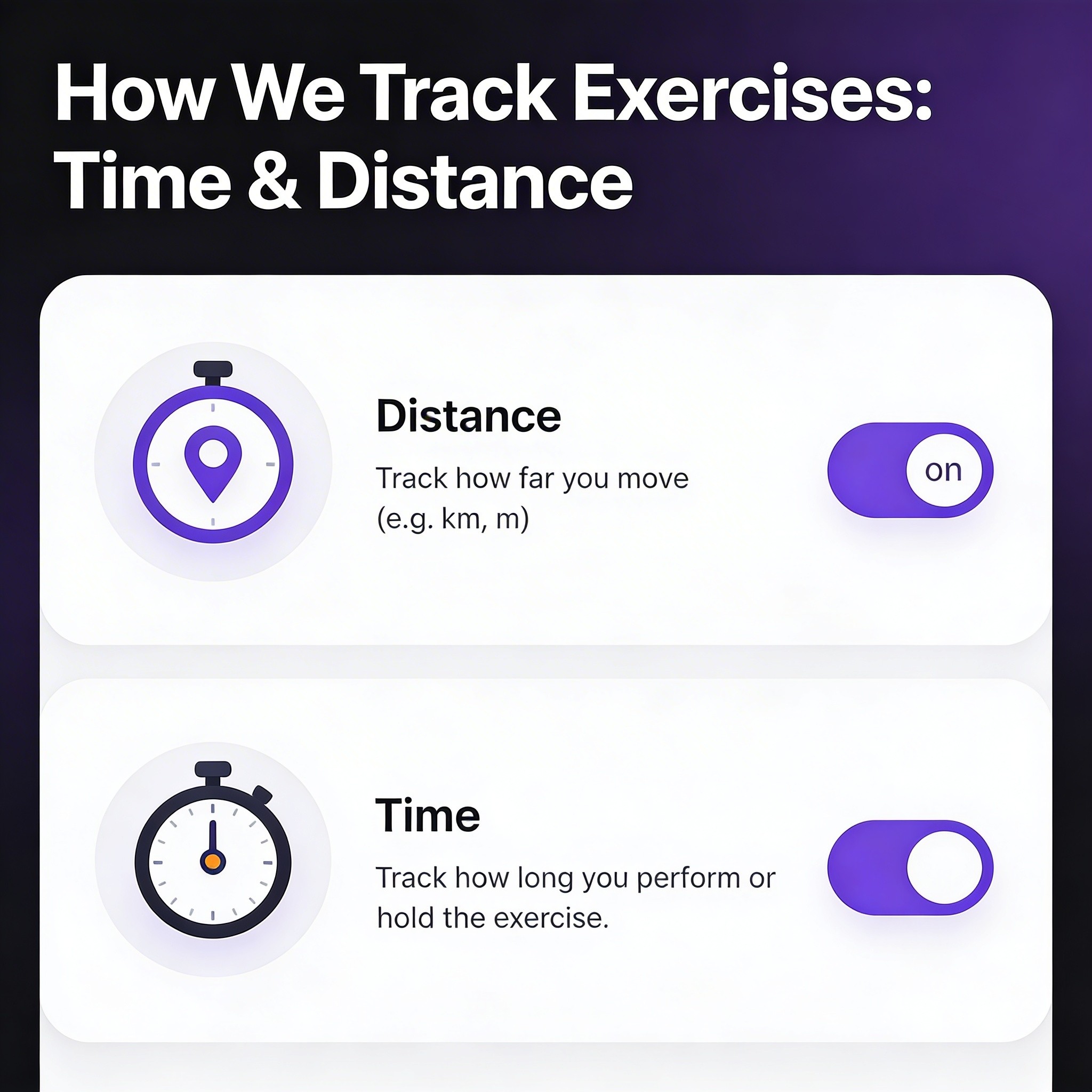
Exercise tracking for distance and time lets you log how far you moved or how long you worked as a distinct metric from reps and sets. For anyone training mixed-modal sessions, this closes the data gap that rep-only tracking creates and gives every exercise the metric it actually requires.
Most gym-goers lose meaningful cardio progress data every single week because their tracking app was built for reps and sets, not rowing intervals or timed efforts. Logging a 1 km row as "1 set" captures zero useful data — no pace, no distance trend, no comparison point across sessions. The problem is not your effort or discipline. Your tracker is structurally wrong for the training you are actually doing.
What Exercise Tracking for Distance and Time Actually Means for Your Workouts
Exercise tracking for distance and time is the ability to log how far you moved or how long you worked during a given exercise, captured as a distinct metric from reps and sets.
That distinction matters more than it sounds. Traditional rep-and-set logging captures load volume for strength work, and it does that well. The problem is that reps and sets are structurally incompatible with exercises like rowing intervals, running efforts, cycling sprints, or timed circuits. These exercises are defined by distance covered or duration sustained, and forcing them into a rep-based framework strips out the data that actually reflects performance.
If you train mixed-modal sessions that combine strength and cardio, if you are migrating from a coach-written template that includes cardio blocks, or if your program already prescribes distances and durations, then your tracking method needs to match the actual structure of your training. When it does, the data you collect is meaningful and actionable. When it does not, you are left with an incomplete picture that cannot tell you whether you improved.
Pocket Fit has launched exercise tracking for distance and time, closing this gap inside a single app so that every element of your session is captured with the metric it actually requires.
Why Rep-Only Tracking Was Holding Your Cardio Progress Back
If your program includes a 1 km row, a 10-minute bike effort, or a 400 m run, logging it as "1 set" in a notes app captures nothing useful. You cannot measure pace. You cannot track distance improvement. You cannot compare time-under-effort across weeks. The data point exists, but it carries no training signal.
The Coach Template Problem: Coach templates often prescribe cardio in distance or time because that is how conditioning work is structured. Static notes apps and spreadsheets force users to strip that structure out or record it inconsistently, which breaks the progression logic the coach originally built in. The program migrator ends up doing extra administrative work just to approximate what the template intended, and the result is still less precise than the original prescription.
The Notes App Problem: For anyone tracking in a notes app or spreadsheet, distance-based exercise tracking and time-based exercise tracking simply do not exist as logging units. Everything becomes a free-text workaround, which means there is no standardised format to compare session to session.
The Social Visibility Problem: For socially-motivated gym regulars, lifting PRs are easy to post and celebrate. A faster 500 m row or a longer sustained effort stays invisible to training partners because it was never tracked in a format that could be shared or compared.
The consequence is straightforward. Incomplete tracking leads to incomplete feedback loops. Without structured cardio progress tracking, you cannot objectively know whether your cardio capacity is improving, plateauing, or declining. This is a tool problem, not a discipline problem. The tracker was wrong for the task.
How Pocket Fit's New Distance and Time Tracking Changes the Way You Log Mixed-Modal Sessions
Within a single Pocket Fit session, you can now log a strength block with reps, sets, and weight, then immediately log a cardio or conditioning block using distance or time. There is no app switching, no manual workaround, and no need to maintain a separate system for cardio data.
Pocket Fit's live workout tracking now captures exercises, reps, sets, weights, distance, and time in one unified session view. This gives you a complete record of what you actually trained, structured in the format each exercise demands. A barbell squat logs as sets, reps, and weight. A rowing interval logs as distance. A sustained bike effort logs as time. Each metric lives in the same session, reviewed from the same screen.
Because Pocket Fit generates AI-powered personalised workout programs that can include time or distance prescriptions, the tracking layer now matches the program structure. You do not need to adapt the program to fit the tracker. The program customisation tools and the logging tools speak the same language, which means progression logic stays intact from prescription through to recorded output.
The update also maintains Pocket Fit's commitment to fast workout logging. Adding distance or time as a logging unit does not add friction. The interface is designed to keep you focused on training, not data entry.
For program migrators specifically: if you have been running a coach's template inside notes or a spreadsheet, Pocket Fit now replicates the full structure of that program including cardio blocks. It becomes a genuine like-for-like replacement with added intelligence layered on top.
Pro Tip: When logging a mixed-modal session, structure your cardio blocks as separate exercises within the same session rather than appending notes to a strength exercise. This keeps your distance and time data isolated in your session history, making it far easier to review progression for each conditioning movement independently.
Smarter Progress Signals Your Training Partners Can Actually See
For socially-motivated gym regulars, one of the most underrated drivers of consistency is visible progress that your training circle can engage with. Lifting PRs have always served this role well because they are easy to quantify and easy to share. Cardio improvements, by contrast, have historically been invisible inside most tracking tools because they were never logged in a shareable, structured format.
Now that distance and time are tracked inside Pocket Fit, those metrics become part of the session history that feeds into Pocket Fit Members, where training partners can see, compare, and engage with real performance data. A faster 2 km row or an increased cycling distance is no longer something you have to describe manually. It exists as a tracked, verifiable data point inside the social feed.
This connects directly to advanced analytics as well. Tracked distance and time data integrates into personalised analytics, so you can review progression curves for cardio work the same way you track favourite exercise progression for strength. Your training partners see a fuller picture of your output, and you see a more complete view of your own improvement.
Visible, credible progress data creates stronger accountability loops. When your peers can see that your run time dropped or your rowing distance increased, the social layer becomes a genuine performance motivator. Community engagement built on real tracked data is more durable than engagement built on estimated or manually typed numbers. Accuracy drives trust in the feed.
How to Evaluate Whether Your Current Tracking Setup Covers What You Actually Train
Before changing tools, it is worth auditing what your current setup actually captures against what your training demands. Use these five questions as a diagnostic:
Does your tracker support distance as a logging unit?
Does your tracker support time as a logging unit?
Can you log strength and cardio in the same session without switching tools?
Is your cardio progress visible to training partners or reviewable in analytics?
Does your tracking structure match the structure of your actual program?
For each "no" answer, map the gap. Questions 1 and 2 point to the need for distance and time tracking. Question 3 is addressed by live workouts and fast workout logging inside a single session view. Question 4 connects to Pocket Fit Members and advanced analytics. Question 5 relates to AI-powered workout programs and program customisation, where the tool generates and adapts programs that include every exercise type you actually perform.
Some users will score well on strength tracking but poorly on cardio tracking. That is common, and the point here is not to overhaul everything at once. It is to identify where the gap is costing you visibility and progress data that you cannot recover after the fact.
If you identify two or more gaps, treat that as a signal that your current tool is structurally mismatched with your training. That is not a motivation issue. It is a systems issue.
Pocket Fit is designed to close all five of these gaps inside one platform. It is available on iOS and Android for immediate download.
Conclusion
If your training includes any distance or time-based work, your tracker needs to match that structure or your cardio progress becomes invisible. Pocket Fit now captures strength and conditioning data inside one unified session view, with AI-powered programs that speak the same language as your log. Audit your current setup, identify the gaps, and choose a tool that reflects what you actually train.
FAQ
What is the difference between tracking distance and time versus tracking reps and sets? Reps and sets measure load volume for strength exercises, while distance and time measure output for cardio and conditioning work. They are structurally different metrics, and using the wrong one strips out the performance data that actually matters for that exercise type.
Can I log both strength and cardio in the same session inside Pocket Fit? Yes. Pocket Fit captures reps, sets, weight, distance, and time within a single session view. You do not need to switch apps or maintain a separate system for cardio data.
Will my cardio progress show up in analytics the same way my strength progress does? Tracked distance and time data integrates into Pocket Fit's personalised analytics, so you can review progression curves for conditioning work the same way you track strength improvements over time.
Does adding distance and time tracking slow down the logging process? No. The interface is designed to keep logging fast. Distance and time appear as native input units alongside reps and sets, with no additional steps or workarounds required.